
Two columns, one evaporator, one lab.
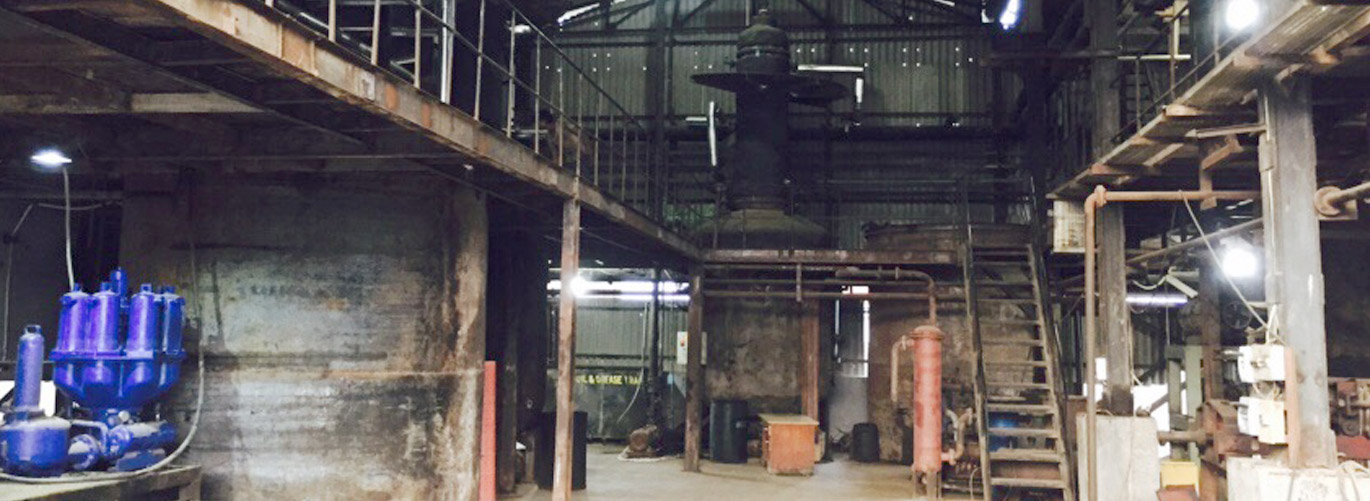
The plant sits at Plot 69, near the Pagoda Rolling Mill. One column dehydrates and takes the light cut. One thin-film evaporator does the molecular distillation under high vacuum. The laboratory grades every lot before a tanker is loaded.
Wiped-film reclamation
The six steps.
High-vacuum molecular distillation. The conditions below are the ones we run, not a textbook's.
Settling
Settling vessel
Raw used oil is drawn from the storage tank into a settling vessel where the solids drop out.
Centrifuge and purifier
Two filters
The oil passes through a centrifuge and an oil purifier, which take out oily sludge, water and organic matter.
Dehydration and light cut
120 °C, then 180 to 220 °C at 710 mm Hg
In the first column, water comes off at 120 °C and the light cut is distilled at 180 to 220 °C under vacuum.
Thin-film distillation
310 to 320 °C at 1 mm Hg
The oil passes through a thin-film evaporator in an induction-heated molecular distillation plant under high vacuum and high temperature. The distillate comes out at about SAE 40 at ambient.
Clay bleaching
Active clay
The distilled oil is bleached with active clay to bring the colour up to a high-colour base oil.
Residue
Incinerator
The semi-solid residue is incinerated so that its oil content burns off completely.
Plant commissioning
We will set one up for you.
Clients abroad ask us to set up used-oil reclamation plants because we have run one for years, not because we sell equipment. The engagement ends when your operators are producing on their own.
Scope
Feedstock, capacity, site
What used oil you can collect, how much per month, what the site and power supply allow. We tell you plainly what a wiped-film unit of that size will produce.
Design and equipment
Columns, evaporator, filtration, incinerator
The same configuration we run at Mamsa, sized to your feedstock: settling, centrifuge and purifier, dehydration column, thin-film evaporator, clay bleaching, residue incineration.
Erection
On your site
Grounding for your team in the technology, the concepts and the methods while the plant goes up, so that nobody is operating a black box.
Trial batches
Five to seven production runs
After erection our engineers run five to seven batches with your operators and hand over a plant that is producing, not one that is merely built.
Despatch
By tanker, with the report.
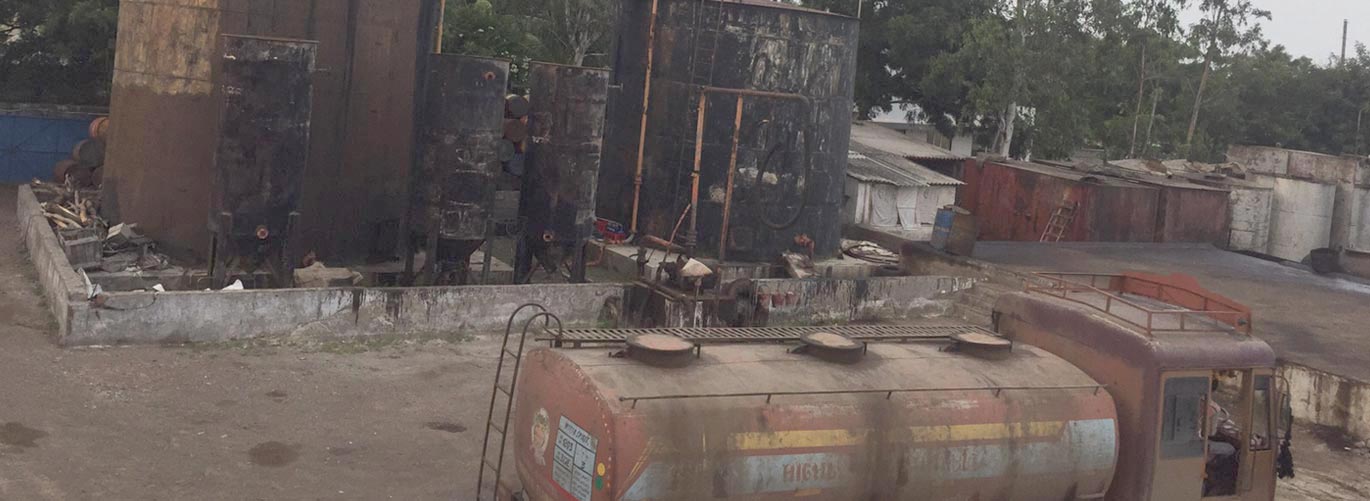
Furnace oil and LDO leave by road tanker. Re-refined oil and base oil go in bulk or drums. Every despatch carries the lot's analysis. For a rate, ring the office on +91 278 242 2421 or the mobile on +91 99250 08686.